Shipped · 2025
Stair-Climbing MuJoCo Robot
A six-wheel delivery robot simulation for comparing PID, MPC, and reinforcement-learning stair traversal.
Overview
Stair Climber is a MuJoCo simulation for a six-wheel delivery robot that can follow residential mission paths while traversing curbs, ramps, and stairs. I worked on turning a broad mobility idea into explicit simulated scenarios, controller comparisons, and telemetry that made the robot's behavior measurable.
Building the MuJoCo Testbed
The first challenge was creating a simulation that was specific enough to expose real stair-climbing issues without becoming too heavy to iterate on. I modeled the six-wheel chassis, actuated climbing bogies, rangefinder sensors, and active payload platform, then built scenarios that moved from simple terrain to a full delivery-style mission.
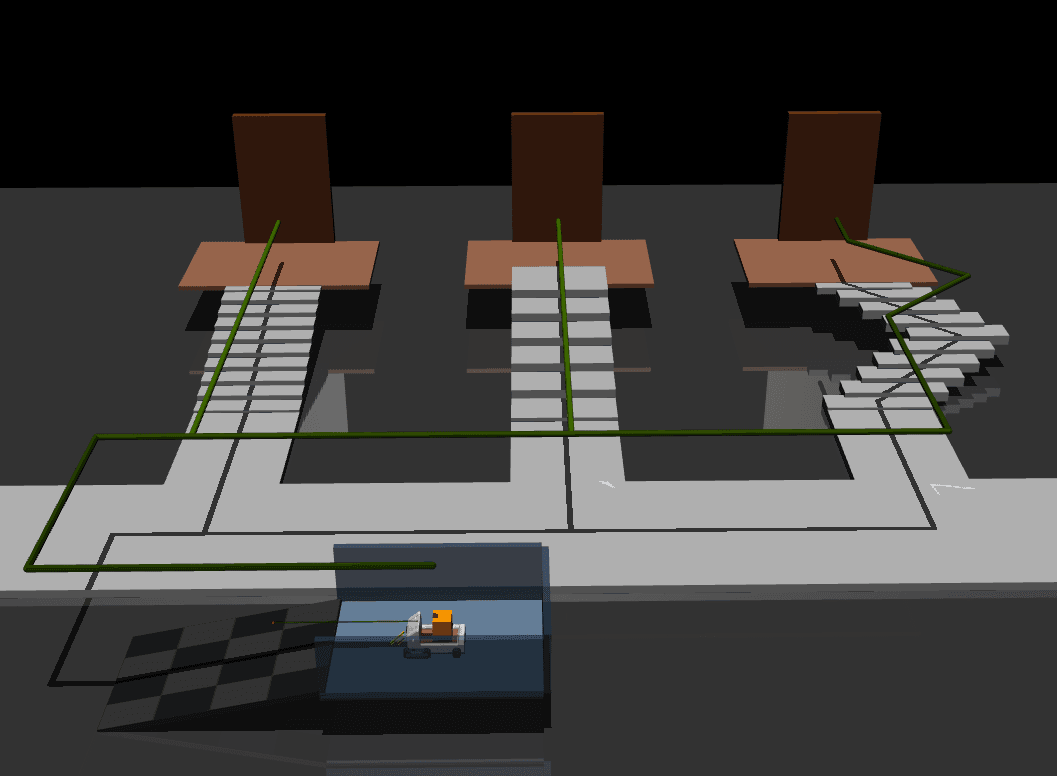
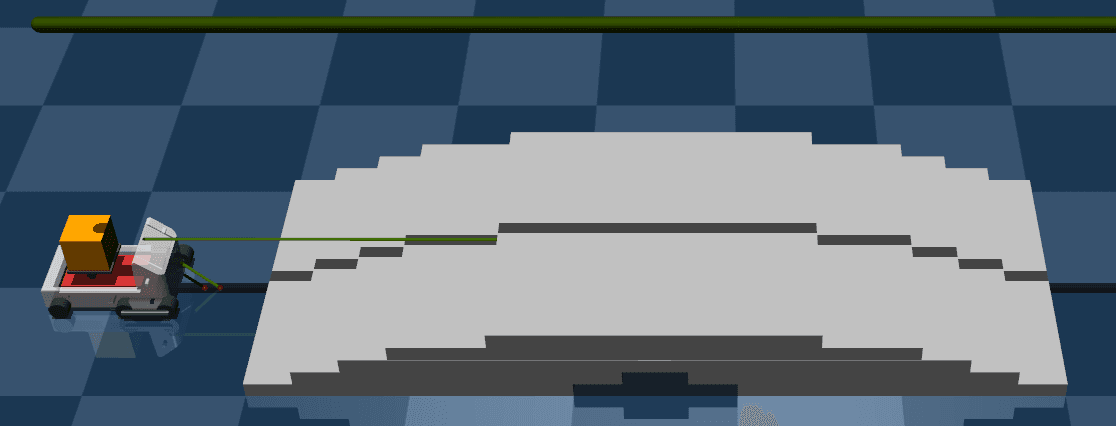
That testbed made it possible to inspect the same robot in progressively harder situations: a curb, a navigation target, a stair pyramid, and a multi-stop residential route with sidewalks, stairs, porches, and delivery targets.
Separating Navigation from Stair Climbing
The robot had two different control problems happening at once: global path tracking across the mission route and local bogie control over contact-rich stairs. I kept those responsibilities separate so the navigation controller could focus on waypoints while the climbing behavior responded to terrain geometry from the rangefinders.
This made each layer easier to evaluate. If the robot missed a route target, I could inspect path tracking. If it tipped, stalled, or carried a bad pitch over a stair, I could focus on the climbing and payload-leveling behavior.
Comparing PID and MPC Tracking
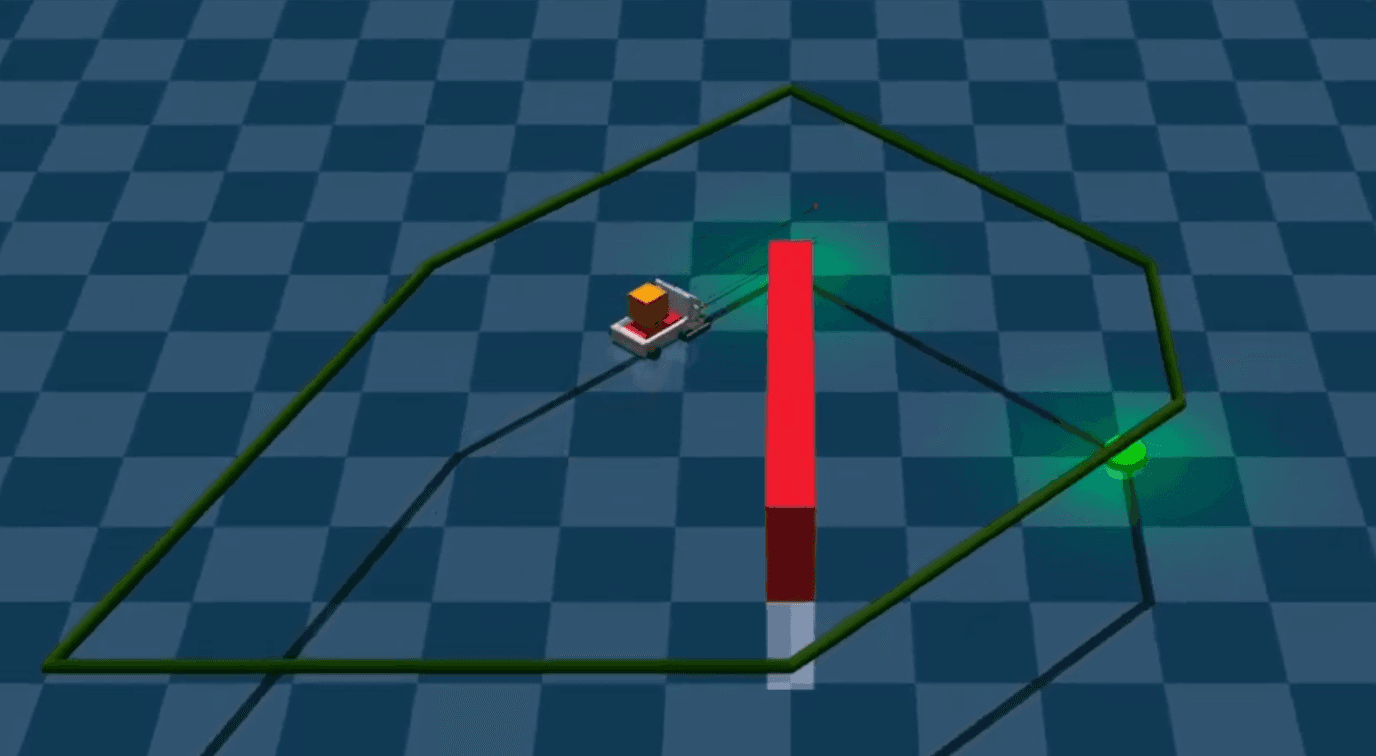
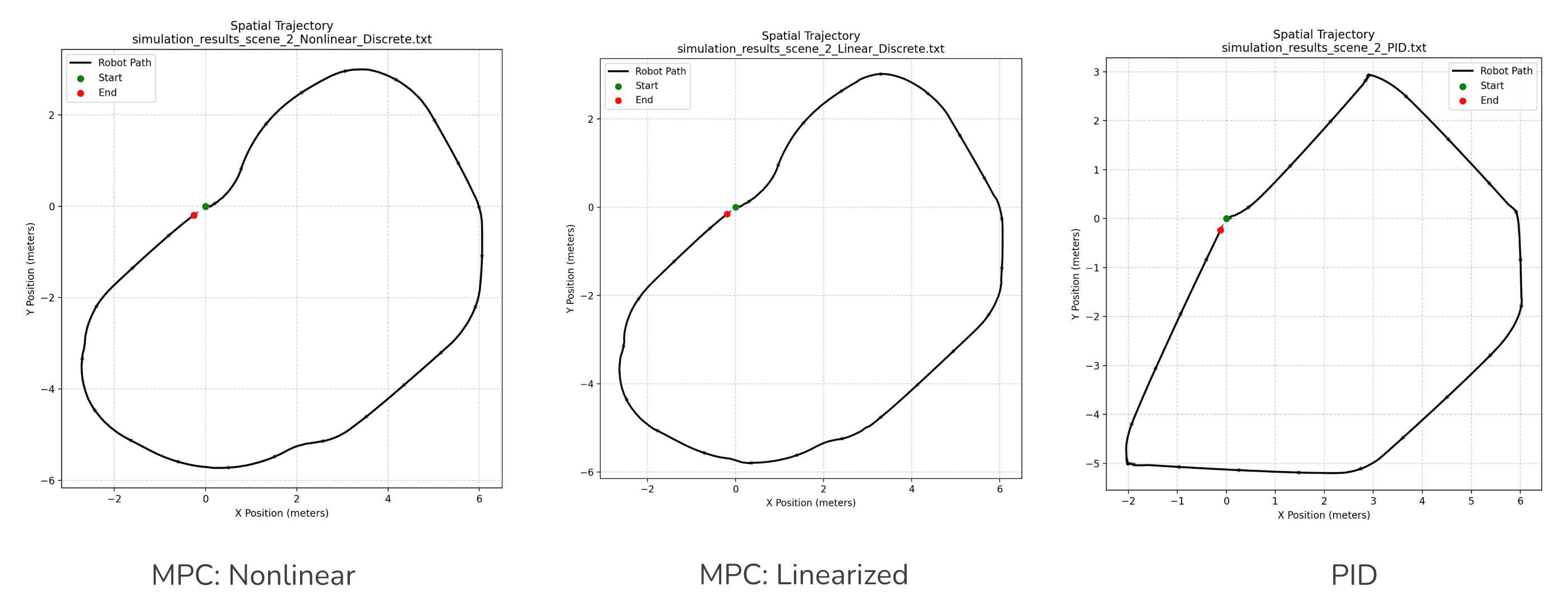
For navigation, I compared a simpler PID-style waypoint tracker with a constrained MPC controller. The MPC path formulated a finite-horizon optimal-control problem using a unicycle approximation, bounded drive and turn commands, terminal boxes, and warm-started trajectories. Within MPC, I compared a linearized model to the nonlinear model from the unicycle kinematics. I found that the linear model produced equivalent tracking results with lower latency in real-time optimized navigation.
The purpose was not just to make the robot move, but to understand what extra structure MPC provided when the route included tight turns and actuator limits.
Testing Reinforcement Learning for Bogie Control
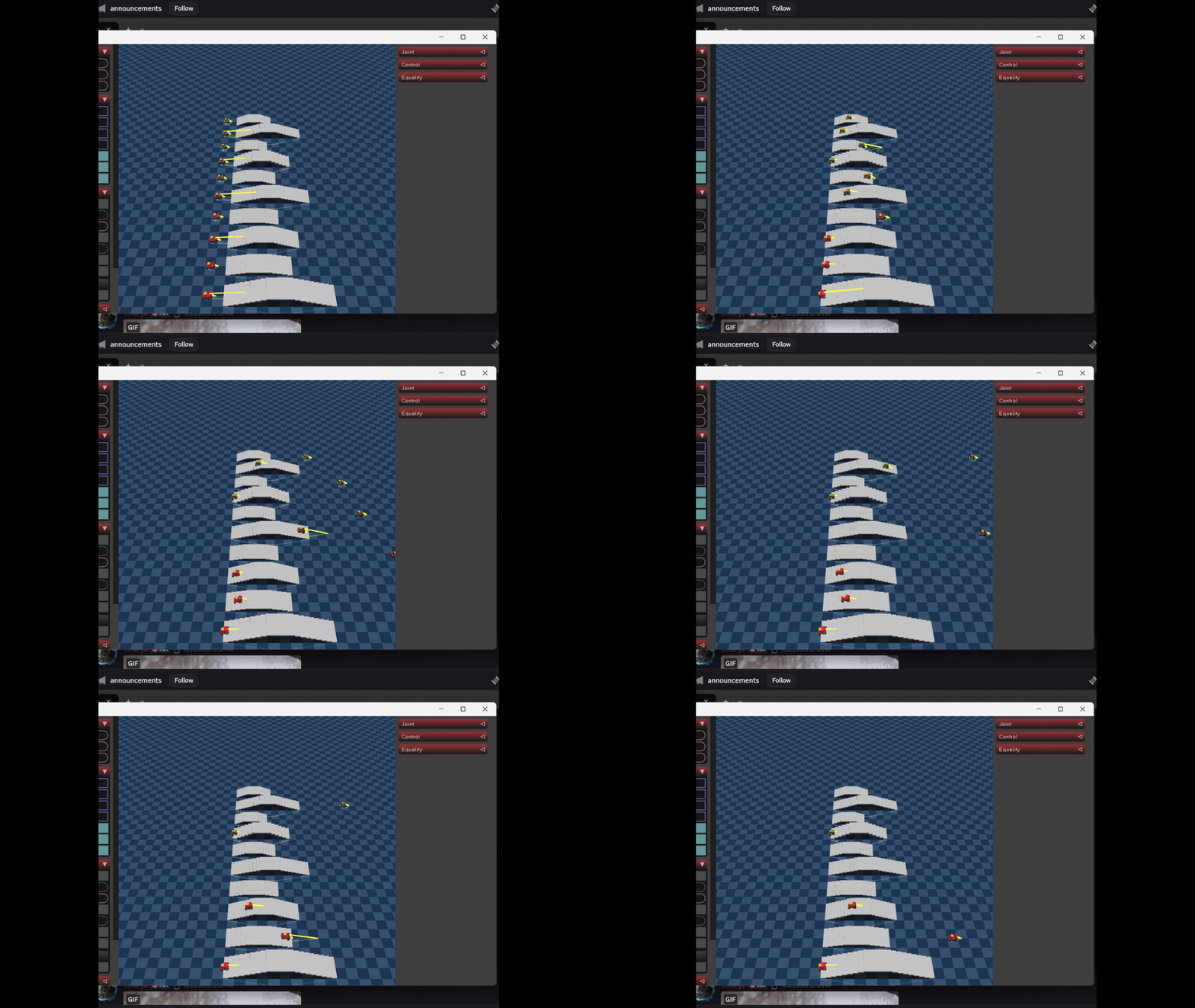
I also explored a PPO-based climbing policy in a procedural stair environment with randomized step heights, depths, and climb/descend cases. The policy observation included robot attitude, rangefinder readings, velocity, current bogie command, and target speed.
The RL work was useful because it exposed the difference between producing a visually interesting rollout and building a behavior that could be inspected, compared, and connected back to mechanical constraints.
What the Simulation Made Measurable
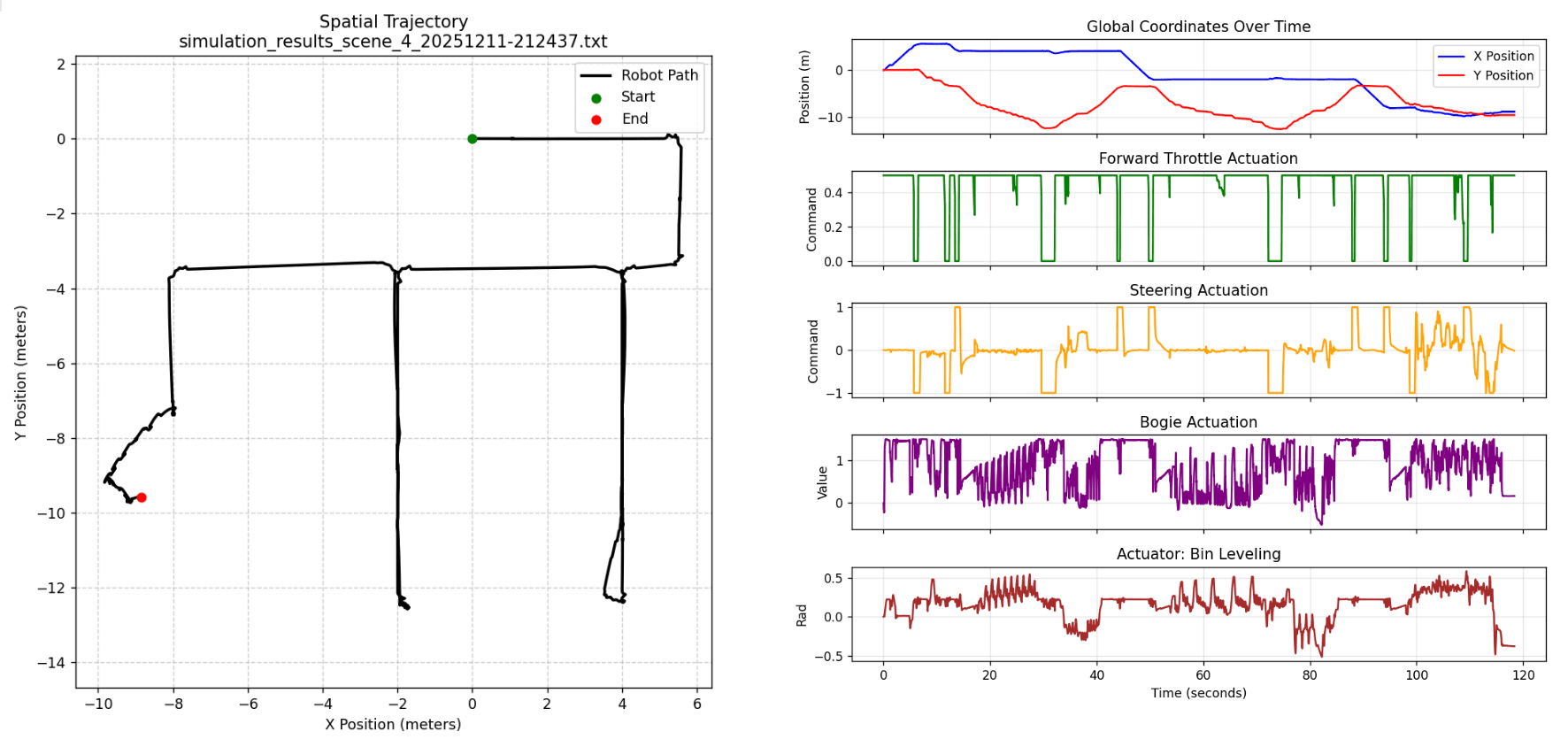
The final value of the project was turning an ambiguous mobility concept into a controls problem with explicit scenarios, sensor assumptions, controller tradeoffs, and reusable logs. Telemetry captured position, yaw, and actuator commands so the team could compare runs instead of relying only on whether a single demo looked successful.